Sunday, March 23, 2014

1f: Designing Student Assessments


“Don’t underestimate the power of formative assessment—for you and your students. Use it not only to give feedback to students, but also to see the gaps in understanding, so that you can readjust accordingly and step in when needed with new or more in-depth instruction.” ~Alexis Wiggins


As teachers we must assess the end product of student learning and most importantly, the process of learning.  Assessments OF learning ensure that students have learned the intended outcomes.  Assessments FOR learning are incorporated right into the instructional process and are used to modify or adapt instruction as needed to ensure student understanding.  Although these assessments are used during instruction, they must be designed as part of the planning process.  These formative assessments are vital for teachers and students to monitor progress toward understanding the learning outcomes.


This chart helps Stephanie's students know what
to include when sharing their thinking.
Elements of Component 1f: 
  • Congruence: Assessments must match learning expectations
  • Clarity: Expectations must be clearly defined
  • Purposeful Design: Assessments for learning must be planned as part of the instructional process
  • Usage: Results of assessment should guide future planning


Will creates learning progressions for students
to follow based on student pre-assessments.
Indicators: 
  • Lesson plans indicating correspondence between assessments and instructional outcomes
  • Variety of performance opportunities for students
  • Modified assessments available for individual students as needed
  • Clear progressions of learning
  • Formative assessments designed to inform minute-to-minute decision making by the teacher during instruction


A proficient assessor...
  • has a method to assess all learning outcomes in the lesson
  • matches assessment types to the learning expectations
  • plans for modified assessments when necessary for students
  • includes clearly written assessment criteria
  • plans to use formative assessment during instruction
  • plans for possible adjustments within their lesson based on formative assessment data

What might this look like?
  • The teacher creates a short questionnaire as an exit ticket in math class.  He uses their responses to organize different groups for the next day's activities.
  • Using her formative assessment data from the previous day's project work, the teacher plans to have five students work on a more challenging extension while she works with six other students to reinforce the previous day's concept.
  • The teacher makes sure her embedded rubric for the research assessment clearly defines proficiency.  She includes specific written feedback when she returns it to the student.

(source)
Looking for fresh ideas for Formative Assessment?  Check out: 


Looking into Digital Assessment opportunities?  Check out: 


Self Reflection: 
Is your instructional planning continually responsive based on formative assessment results?
Do students know what proficiency looks like for their target they are working towards?


Comment questions: 


  • What do you love about assessment?  What frustrates or challenges you?


Friday, March 14, 2014

4f: Professional Responsibilities

“A teacher’s integrity is demonstrated, most importantly, through honesty.  Professional educators can be counted on to do what they said they would do, to maintain confidentiality and to support the best efforts of colleagues.”
-C. Danielson


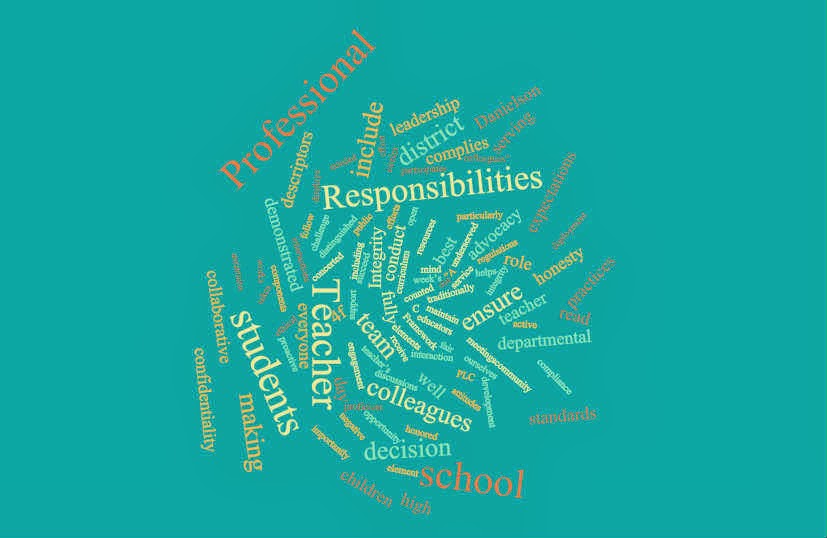
This week’s element is demonstrated every day in interactions with students and colleagues.  How we conduct ourselves and follow through with professional responsibilities are components of Danielson Framework 4f.  The elements of 4f: Professional Responsibilities include: Integrity and ethical conduct, service to students, advocacy, decision making and compliance with school and district regulations.


The descriptors for a teacher who is proficient in professional responsibilities include:
  • Teacher displays high standards of honesty, integrity, and confidentiality in interaction with colleagues, students and the public.
  • Teacher is active in serving students.
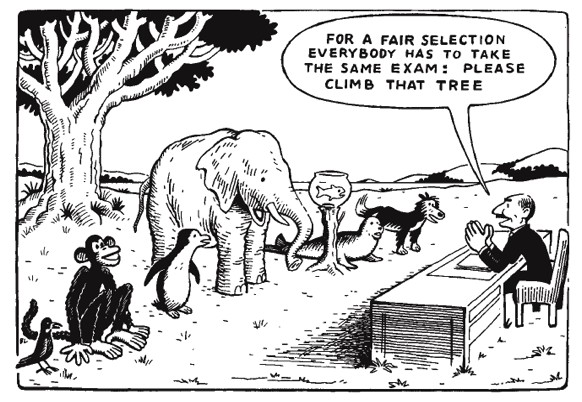
  • Teacher works to ensure that all students receive a fair opportunity to succeed.
  • Teacher maintains an open mind and participates in team or departmental decision making.
  • Teacher complies fully with school and district expectations, including engagement in PLC discussions and meetings/community circles, as well as collaborative curriculum development and deployment.


The descriptors for a teacher who is distinguished in professional responsibilities include:
  • Teacher is highly proactive in serving students, seeking out resources when needed.
  • Teacher makes a concerted effort to challenge negative attitudes or practices to ensure that all students, particularly those traditionally underserved, are honored in the school.
  • Teacher takes a leadership role in team or departmental decision making and helps ensure that such decisions are based on the highest professional standards.
  • Teacher complies fully with school and district expectations, taking a leadership role with colleagues.
 
Throughout this year, there have been significant practices that have been launched and lifted by the professionals at STEM and Hawthorne.  The commitment to providing high quality PBL experiences, as well as iPad assisted personalized learning paths is rooted in an advocacy for students. The belief that we are here to move children forward is a powerful force in changing the lives of children.  This work could not have been done in isolation and requires a team focused on the same goal.  The time and expertise you share within your level and on vertical teams creates a bank of talents that we all draw from together.  Thank you for the wealth of collegiality you have brought to your team’s collaborative table...every day!


This week's question...not school related!
What is the best book you have read lately (for enjoyment) that you could recommend to everyone? Spring break is coming up fast and everyone needs a good read ;-)

Monday, March 3, 2014

4e: Growing professionally

Continuing development is the mark of a true professional; it is an ongoing effort that is never completed.  -C. Danielson

What are the current and future needs of our students and how are we adapting to meet those needs?  

The answers to those questions change every day, with every learner and will never be answered completely. This week we are examining component 4e from the Danielson framework, Growing Professionally. The elements of 4e include: enhancement of content knowledge and pedagogical skill, receptivity to feedback from colleagues and service to the profession.


A proficient teacher will seek out opportunities for professional development to meet the needs of his/her learners.  As we continue to move students towards the in-depth application that the core requires, using strategies and tools that were not in the academic standards in the past, we are all feeling the need to seek out TDP and PSI courses.  Some have entered graduate, licensure or certificate programs to grow expertise around proven instructional practices.


A proficient teacher also welcomes feedback from colleagues when made by supervisors or when opportunities arise through professional collaboration. Gone are the days where we wait for an evaluation from an administrator to get feedback to help shape our practice.  Now, we use all collaborative parties to seek out new strategies and explore innovative teaching practices that will move our learners forward.


Finally, a proficient teacher participates actively in assisting other educators. The feedback loop should go both ways.  We all have areas for growth and we all have areas where our expertise can support others.  Growing professionally is a community effort.

A distinguished teacher ensures that these efforts are effective through action research and seeks out feedback from both supervisors and colleagues.
In addition, a distinguished teacher initiates important activities to contribute to the profession.  If you have ever hosted a field placement student or mentored a new teacher, this is where you have helped lift the teaching profession as a whole.

Our practices have changed more in the last 5 years than in any time in the history of teaching a learning.  With the arrival of our Waukesha ONE technology, Project Based Learning frameworks and Proficiency Based Learning Pathways, we have all cycled through being a novice on some piece.  As we move our students into being 21st century learners, we ALL must live in that 21st learner space as teachers!  Our growth is triggered by figuring out what we “don’t know”, and is motivated by the thirst to “know more”. When we implement these new practices with our students, and refine them through vital feedback, we create the innovative space to move all students forward.  


Choose one of three questions to respond to in the comment section below:
-Who do you turn to for feedback?  
-How do you get the information you need to refine the practices you use with students?
-What new practice have you launched as a result of professional development or feedback THIS YEAR to enhance the learning of your students?

Friday, February 21, 2014

4C: Communicating with Families

We work with many families and their level of involvement varies, it is our responsibility to connect and provide opportunities for them to understand our instructional programs and their child's progress.  Teachers establish this relationship with families by communicating to them about the instruction that is taking place, conferring with them about individual student growth, and inviting them to be part of the educational process.  The importance of regular communication cannot be overstated.  

The elements of component 4c are:

  • Information about the instructional program 
    • The teacher frequently provides information to families about the instructional program.
  • Information about individual students
    • The teacher frequently provides information to families about students’ individual progress.
  • Engagement of families in the instructional program
    • The teacher frequently and successfully offers engagement opportunities to families so that they can participate in the learning activities.
A proficient teacher: 

The teacher provides frequent and appropriate information to families about the instructional program and conveys information about individual student progress in a culturally sensitive manner. The teacher makes some attempts to engage families in the instructional program.
What does this look like?

  • Sending home a weekly newsletter to describe current class activities and learning goals, PBL projects, field trips, etc.
  • Creating a monthly progress report that is sent home with each student.
  • Keeping StandardScore up to date so that parents have access to current student information.
  • Utilizing BB9 to house instructional materials so parents can connect to the work happening at school.
  • Involving parents in at home learning opportunities.
A distinguished teacher: 

The teacher communicates frequently with families in a culturally sensitive manner, with students contributing to the communication. The teacher responds to family concerns with professional and cultural sensitivity. The teacher’s efforts to engage families in the instructional program are frequent and successful.
What does this look like?

  • Students create information to take home that shows what they are learning in science.
  • Students maintain a daily reflection log describing what they are learning that goes home each week for parents to read.
  • Students design an inquiry project to work on with their family connected to the learning at school.

Here are two examples of communications that are happening in our schools:


This infographic has ideas for utilizing social media to connect and communicate with parents:


Other resources on Communicating with Families: 
Reflect in the comments: 
How have you involved and connected families to the learning that is happening in your classroom?

Thursday, January 30, 2014

4b: Maintaining Accurate Records


We hope everyone enjoyed the Polar Vortex: Part 2! From many conversations that we have had, it appears that many people took the opportunity to catch up on some paperwork and even plan ahead to the months ahead. It's amazing how productive we can be when we "borrow" a few hours that we didn't think we had! This week's blog focuses on component 4b: maintaining accurate records. This component encompasses student information connected to tasks and learning, as well as non-instructional recording keeping...something many teachers were able to do on Monday and Tuesday.

Often teachers may feel that there is an endless parade of paperwork that travels back and forth to school in a work bag.  Fortunately, our digital tools are offering many ways to lighten the load, both literally - by going paperless, and figuratively - with more efficient tools!  Sometimes, that digital clutter can feel just as overwhelming...especially when you can’t find something in Drive!


While there are many aspects of “records” we could dive into, nothing is more important than the ways we give feedback regarding and document evidence of student learning.  As we move forward with Proficiency Based Learning systems we will see a change in our methods for communicating progress to parents.  Our current system of “grading” students does not speak to the growth students make when given a clear learning plan.  Maintaining accurate records of demonstrated proficiencies is essential for communicating progress to parents within our current system, as well as when we move forward to a new system.  We need artifacts and evidence of demonstrated student learning to ground our assessments as well as plan our instructional next steps.  

When thinking about the accuracy of our records or gradebooks we should consider whether we are continuing to ask the question “how will we know if a student is proficient?”  And also “how am I engaging my students in determining what is proficient?”.  It is important to note that this component stretches beyond ensuring Standards Score is up to date, fair and accurate.  There are many additional ways teachers keep records to support moving students forward.  Analyzing Student Work protocols, checklists, conferring notes, lesson plans and intervention summaries all ensure that our tiers of instruction are supporting all learners within our schools.


The elements of component 4b include: maintaining information on student completion of tasks (the process) as well as maintaining information on student progress in learning (the assessments).  Additionally, maintaining information on non-instructional activities is an element in this component.
What separates a proficient from a distinguished teacher in this component is the distinguished teacher’s ability to engage the learners in those three elements.


This week’s question:
What type of records do you maintain that give the you most insight into what your students have learned and/or your instructional next steps?

Saturday, January 18, 2014

4a: Reflecting on Teaching


Pausing to reflect is essential to continuous improvement of your practice.  Taking time to process your thinking after any instructional event and analyzing the many decisions you made in the planning and implementation of your lesson are important.  By thinking about these things and the impact they had on student learning, teachers can determine where to focus in making revisions and choose which parts of the lesson need continued instruction in the future.  Reflecting on Teaching is component 4a in the Danielson Framework.

How do you reflect?

  • Through collegial conversations?
  • Journal writing?
  • Examining student work?
  • Conversations with students?
  • Thinking about your teaching?
Reflecting with accuracy and being able to use what you learn in your future teaching is an acquired skill.  Mentors, coaches, and principals can help you develop these skills through supportive and deep questioning.  Over time, thinking both reflectively and self-critically while analyzing your instruction through the lens of student learning becomes a habit of mind, leading to improvement in teaching and learning.

The first element is ACCURACY.
As teachers gain experience, their reflections on practice become more accurate, corresponding to the assessments that would be given by an external and unbiased observer.  Reflections are accurate and teachers can provide specific examples from a lesson to support their judgements.

The second element is USE IN FUTURE TEACHING.
If the potential of reflection to improve teaching is to be fully realized, teachers must use their reflections to make adjustments in their practice.  As their experience and expertise increases, teachers draw on an ever-increasing repertoire of strategies to inform these adjustments.

The Danielson rubrics state the following for a teacher who is proficient in 4a: 
The teacher makes an accurate assessment of a lesson's effectiveness and the extent to which it achieved its instructional outcomes and can cite general references to support the judgement.  The teacher makes a few specific suggestions of what could be tried another time the lesson is taught.

A distinguished teacher offers specific alternate actions in their thoughtful reflection, complete with the probable success of different courses of action.


A shout out to the PBL collaboration and learning that took place this week in Madison!  Thanks to Sarah, Courtney, Rachel, Lindi, Sarah, and Richelle!  You'll get a chance to hear about their new learning and the fantastic projects they've planned this week!


This week's comment questions: 
Reflect: what did you do this week that worked well for kids?  
Why did it work?
What didn't work the way you had planned?
What will you do next week because of what you learned this week?

Sunday, January 12, 2014

4D: Participating in a Professional Community

4D: Participating in a Professional Community


Colleagues are an amazing resource and professional educators know that their students benefit when they take advantage of the wealth of expertise colleagues carry.  Danielson’s component 4D: Participating in a Professional Community looks at four different ways teachers connect with the professional community that surrounds them.


The first element is Relationships with Colleagues.  During the school year, we often spend more time with our colleagues than we do our own families!  Establishing and growing positive relationships with the members of your team enhances all of the work you do together.  Relationships are built on mutual support and a willingness to share.  On the other hand, competition has been shown to be a factor that degrades relationships with colleagues.  We are all in this together!  Adhering to established group norms builds trust between team members and nurtures these relationships.  


The second element, Involvement in a Culture of Professional Inquiry, ties directly to our PLC work. Much like we provide opportunities for inquiry for our students, teachers must engage in collaborative inquiry as we develop our practice.  By answering the PLC questions related to content, assessment and student learning, teachers design instruction that moves students forward...and then they also have the student data to prove it!


Service to the School, the third element in this component, is how teachers commit to building-wide work outside of their own classrooms.  Through participation on the Vanguard Team, PBIS or Student Engagement Teams, Building Leadership and School Improvement Teams, teachers impact all of the learners in the building and contribute their expertise and leadership.  There are so many additional opportunities that teachers jump at making happen for students and families outside of the classroom walls,  it would be impossible to list them all here.  Hawthorne and STEM both are blessed with incredibly committed teachers who step up to make our buildings amazing places for students to THRIVE!  We are fortunate to have you ALL.


Finally, Participation in School and District Projects, is another realm where teachers connect to a greater professional Community.   If you have ever worked on a summer curriculum committee, taught or taken a PSI or TDP course, joined a collegial study or district committee you know how that work adds to the greater needs of SDW but also provides new insights to bring back to your classroom.  


The Danielson rubric states the following for teacher who is proficient in 4D:
-Relationships with colleagues are characterized by mutual support and cooperation.  The teacher actively participates in a culture of professional inquiry and volunteers to participate in school events, making a substantial contribution.
A distinguished teacher is one who takes a leadership role in the activities he/she participates in.


A sincere thank you for your participation in the school and district community.  Your work keeps moving us all forward!


Today’s reflective question for the comment section below:
*What has one of your colleagues done that helped nurture relationships with the people around them?  Appreciation shout-out time!